- Condenser
- Refrigerator Evaporator
-
Compressors
Refrigerator Compressors Shop all
-
Motors and Fans
Motors and Fans Shop all
-
Refrigerator Accessories
Refrigerator Accessories Shop all
-
Air Conditioner Accessories
Air Conditioner Accessories Shop all
- Refrigerants
-
Repair Tools
Repair Tools Shop all
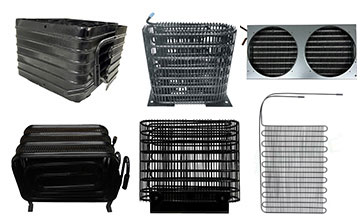
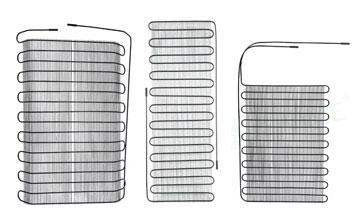
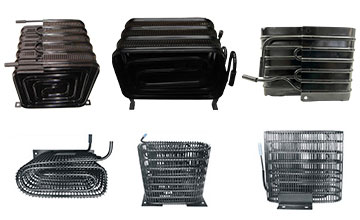
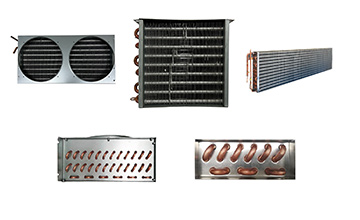
What is the working principle of a condenser?
Sep 17,2026 - 11:45 Reading:7
Many refrigeration appliances such as air conditioners and refrigerators rely on condensers. Although it seems simple in structure, it undertakes key tasks including medium phase change, heat recovery and release, and system pressure regulation. It acts as a "cooling hub" to ensure the stable operation of various thermodynamic cycle systems. Simply put, the core function of a condenser is to cool and liquefy high-temperature gaseous media through heat exchange while releasing the latent heat carried by the media. It realizes energy transfer and offset of energy loss, providing basic conditions for system circulation.
The core working principle of the condenser is: phase change heat transfer and convective heat transfer, which follows the second law of thermodynamics, meaning heat spontaneously transfers from high-temperature objects to low-temperature objects. The whole working process can be divided into two core stages: heat release stage and medium phase change stage. First, the high-temperature and high-pressure gaseous medium generated by system operation continuously flows into the heat exchange cavity of the condenser. At this time, the temperature of the gaseous medium is much higher than that of the cooling medium outside the condenser, forming a stable temperature difference that drives heat transfer. The schematic diagram is shown below.
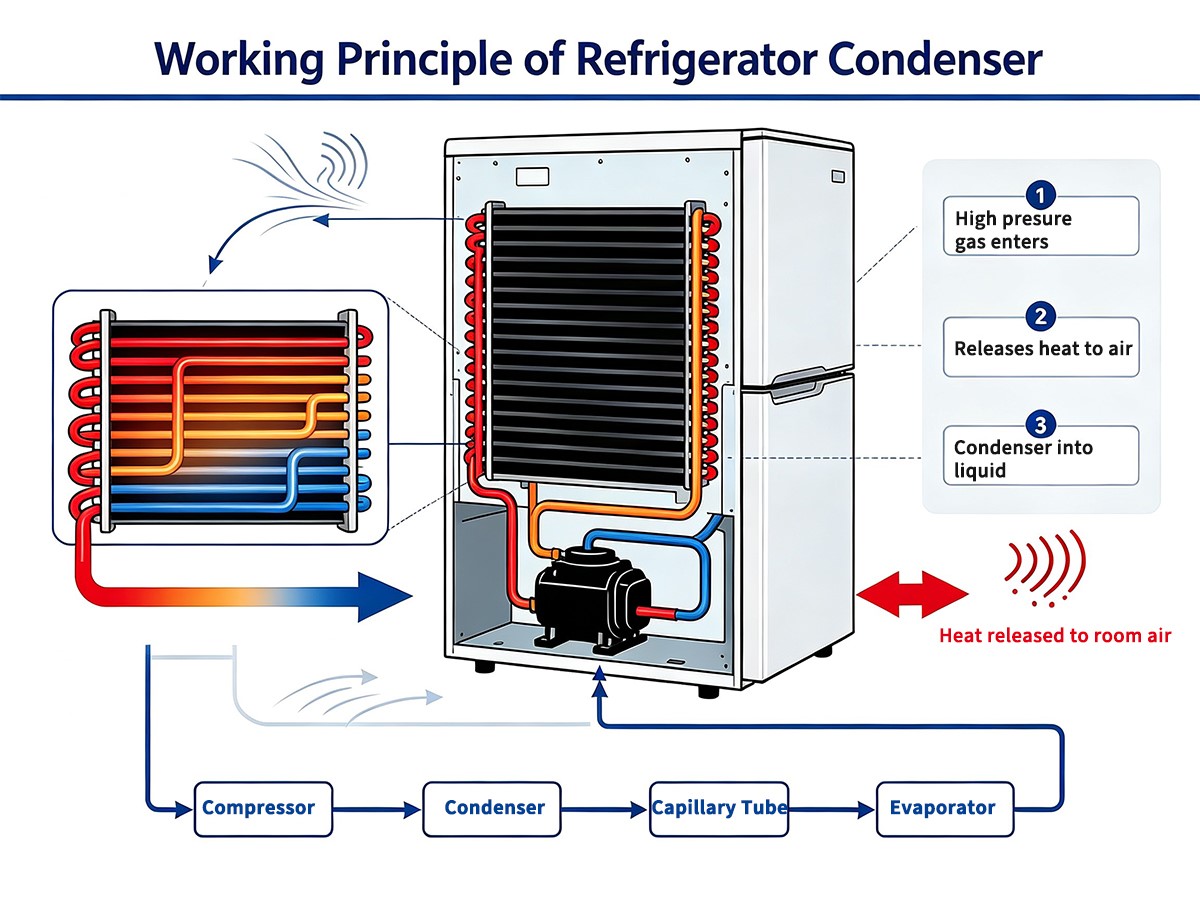
During heat exchange, the high-temperature gas stays close to heat transfer structures such as heat exchange tube walls and fins. It transfers its sensible heat to the outer wall of the equipment by thermal conduction, and then the heat is passed to the external cooling medium through the outer wall. As heat keeps dissipating, the temperature of the gaseous medium drops continuously. When the temperature falls to the saturation temperature under the corresponding pressure, phase change occurs and the gas gradually condenses into liquid. In this process, the medium releases a large amount of latent heat of vaporization, which is the main source of heat exchange in the condenser. Compared with sensible heat exchange, latent heat transfer during phase change has higher heat transfer efficiency and greater energy capacity.
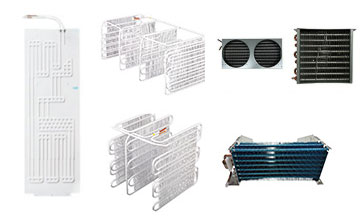
According to different cooling methods, condensers are mainly classified into water-cooled, air-cooled and evaporative types. Equipment of different types has slight differences in heat exchange details, yet the core phase change principle remains the same. Water-cooled condensers are widely used in large air conditioners and industrial refrigeration units. Circulating cooling water serves as the low-temperature heat exchange medium. The cooling water continuously flows outside the heat exchange pipes and keeps taking away the heat released by the medium. The heated cooling water flows into cooling towers for cooling and reuse, featuring high heat exchange efficiency and stable cooling performance.
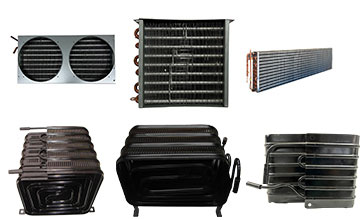
Air-cooled condensers are commonly found in household air conditioners and small refrigeration equipment. They use fan-forced air as the cooling medium. Airflow quickly washes the surface of heat exchange fins to remove heat. They require no water supply and are easy to install, suitable for small and medium-sized equipment scenarios. Evaporative condensers combine the advantages of water cooling and air cooling. Sprayed water absorbs heat through evaporation to assist cooling, with heat exchange efficiency between the other two types. They are often used in industrial cooling and cold chain equipment.
The complete working cycle of a condenser is critical to the closed-loop operation of thermodynamic systems. Take the most common refrigeration system as an example. The compressor compresses low-temperature low-pressure gaseous refrigerant into high-temperature high-pressure gas, which is sent into the condenser for heat exchange and liquefaction, turning into normal-temperature high-pressure liquid refrigerant. Afterwards, the liquid refrigerant is depressurized and cooled via the throttling device, enters the evaporator to absorb heat and vaporize to cool the space. Finally, the gaseous refrigerant flows back to the compressor to complete the whole refrigeration cycle. Without the liquefaction and heat release process of the condenser, the refrigerant cannot change its state, and the refrigeration cycle will be completely interrupted.
Condensers play an even more vital role in power, chemical and other industrial fields. In thermal power plants, high-temperature exhaust steam after work in steam turbines enters the condenser and is cooled into condensed water by cooling water. This not only recycles water resources, but also rapidly reduces the exhaust pressure of the steam turbine, increases the pressure difference for unit work, greatly improves power generation efficiency and cuts energy loss. In chemical reaction devices, condensers can rapidly cool reaction tail gas and steam, separate and purify media, and ensure stable and controllable chemical reactions.
The working efficiency of a condenser directly determines the energy consumption and performance of the whole set of equipment. In daily use, problems such as dust and scaling on heat exchange surfaces, blocked air ducts and turbid cooling water will hinder heat transfer, resulting in reduced condensation effect, higher equipment energy consumption and poorer cooling or heating performance. Therefore, regularly cleaning heat exchange structures and ensuring smooth circulation of cooling media is the key to maintaining efficient operation of the condenser.
In summary, a condenser is core equipment for energy conversion relying on heat transfer driven by temperature difference and medium phase change. Through the core process of "gas releases heat and liquefies to store heat", it completes the release and transfer of thermal energy, supporting the closed-loop operation of refrigeration, power generation, chemical and other systems. As basic equipment in thermal engineering, it adopts a simple and efficient working principle, making it an indispensable part of modern industrial and civil equipment, and profoundly affecting equipment operating efficiency and energy utilization level.
.jpg)


Subscribe for more updates
Get instant updates about our new products and special promos!
