- Condenser
- Refrigerator Evaporator
-
Compressors
Refrigerator Compressors Shop all
-
Motors and Fans
Motors and Fans Shop all
-
Refrigerator Accessories
Refrigerator Accessories Shop all
-
Air Conditioner Accessories
Air Conditioner Accessories Shop all
- Refrigerants
-
Repair Tools
Repair Tools Shop all
How to Choose Custom Air Conditioning Remote Controls?
Sep 15,2026 - 08:38 Reading:20
An air conditioning remote control serves as a critical control interface for AC units, activating various functions of the equipment. Your selection should take pricing, workmanship, operating environment and durability into consideration.
When customizing remote controls, many buyers only focus on cost while overlooking key details such as infrared protocols, button layout, housing material and compatibility. This often leads to common issues including insufficient remote range, signal errors, unstable mass production quality, and customs detention due to missing certifications for exported goods.
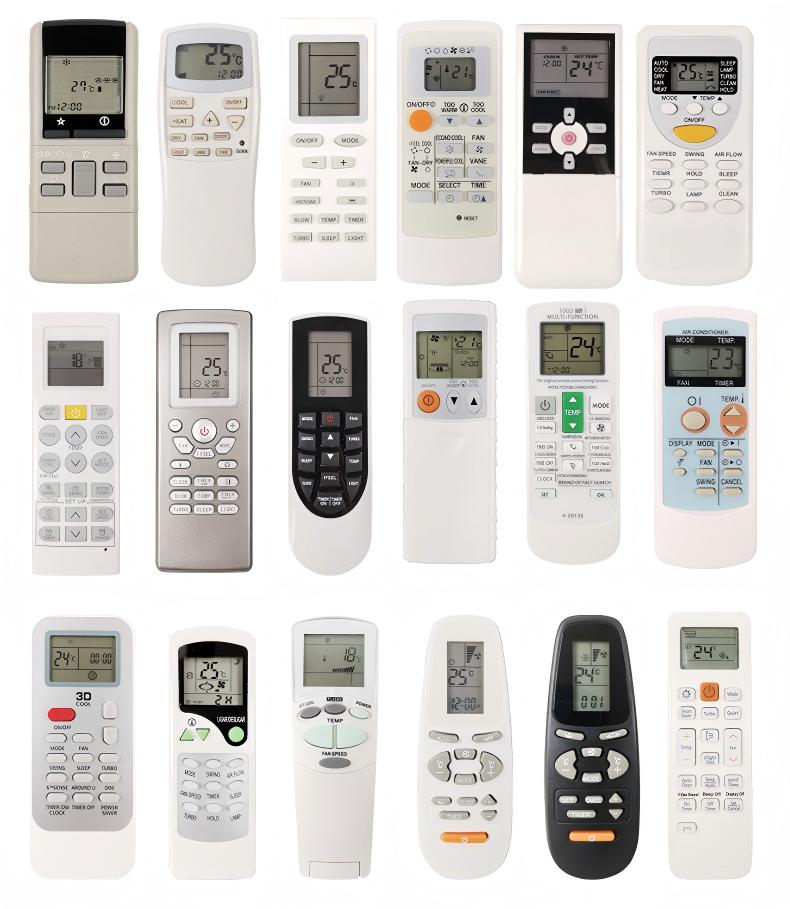
1. Clarify Your Actual Requirements for Custom Remotes
Before contacting manufacturers, define your requirements clearly and distinguish between simple modified customization and full new development customization. These two options differ greatly in cost, minimum order quantity (MOQ) and lead time.
1.1 Simple Modified Customization
Also known as existing housing reuse customization, this solution uses ready-made public mould casings from remote control manufacturers with partial adjustments. It is the most widely adopted option for refrigeration equipment suppliers.
Customizable items: Logo silk printing, revised button text, changed housing colour and updated packaging. The internal mainboard and infrared solution remain fully mature and unchanged.
Advantages: Little or no mould cost; short lead time, samples available within 7–15 days; low MOQ with many manufacturers accepting orders of several hundred units; validated mature mainboard with low failure rates from mass production.
Suitable applications: Remotes for commercial refrigerators, matched air conditioners and cold room units with basic functions and no special button logic requirements.
Limitations: The housing shape and button arrangement cannot be drastically changed; only minor adjustments on the existing structure are allowed.
1.2 Semi-Custom Solution
A proven mainboard solution is retained, while a new mould is produced for the outer casing. Button layout and housing shape can be freely designed without modifying the internal circuit board.
Advantages: High flexibility in appearance to build exclusive brand image; mature mainboard eliminates rework on infrared protocol tuning and keeps R&D costs manageable.
Disadvantages: Customers bear the housing mould cost ranging from a few thousand to 20,000 depending on structural complexity; higher MOQ generally at thousands of units; mould lead time of 30–45 days.
1.3 Full Turnkey Customization
Circuit boards, firmware and outer casings are all developed from scratch. Button logic, infrared codes and functions can be fully customised. Complex features such as multi-unit linkage, scheduled group control, multi-mode switching, temperature memory, child lock and custom backlighting are available.
Advantages: Fully tailored to match your product functions; exclusive solution that competitors cannot directly copy.
Disadvantages: High development cost for PCB, firmware and structural design; expensive moulding; long project cycle of 2–3 months; high MOQ, suited only for large brands with annual demand of tens of thousands of units.
2. Core Hardware Selection
After confirming your customization scope, evaluate hardware solutions carefully. Many remotes look identical externally, yet perform differently in real-world use due to these subtle details.
2.1 Infrared Transmitting Solution (Top Priority)
The vast majority of air conditioner remotes adopt IR infrared solutions. RF radio frequency remotes are used only in a small number of industrial scenarios.
Air conditioners do not use universal coding! Mainstream protocols include NEC, Hitachi, Sanyo, RC5 and more. The first step for custom remotes is confirming the code supported by your receiving mainboard. Mismatched coding will result in zero response when pressing buttons.
Prioritize 940nm infrared emission diodes. Low-cost remotes use cheap transmitters that deliver only around 5 meters of control range and easily fail under strong sunlight. High-quality transmitters achieve an operating range of 8–12 meters in open spaces with stronger resistance to sunlight interference.
Air conditioning remotes commonly use a 38KHz carrier frequency. Double-check this parameter during selection; mismatched carrier frequency prevents the receiver board from detecting signals.
RF remote controls support through-wall operation and do not require line-of-sight alignment to the device. However, they come at a higher cost and need paired receiver modules. They are rarely applied for regular air conditioners and reserved for large commercial units.
2.2 Button Solution Selection
Two main button types are available: conductive rubber (silicone) buttons and membrane buttons. Silicone conductive rubber dominates the air conditioning remote market.
Silicone buttons feature soft tactile feedback and moderate cost, and can be made with basic water and dust resistance, ideal for long-term use on industrial and commercial equipment. Drawback: Long-term frequent pressing wears the conductive carbon granules, causing some buttons to stop working after years of use. Require manufacturers to adopt high-carbon conductive silicone to extend service life, with rated button life ≥100,000 presses.
Membrane buttons enable ultra-thin remote designs but have stiff feedback and mediocre waterproof performance, mostly used for slim panels.
Optional extra function: button backlighting, available in cold light and LED types for night-time operation. Backlight increases cost and power consumption, draining batteries faster. You can omit backlighting to cut costs if night operation is unnecessary for your equipment.
2.3 Power Supply Options
Two common choices:
2 × AAA batteries (7#): Industry standard. Easy procurement and simple battery replacement for end users. 3V voltage, the top pick for commercial supporting equipment.
CR2032 coin cell: Mostly used for ultra-thin remotes. Shortage: low battery capacity requiring frequent replacement, not recommended for high-power backlight applications.
Built-in rechargeable lithium batteries are not recommended. They raise costs, complicate certification and create troublesome after-sales maintenance, and are rarely used for standard air conditioning and refrigeration supporting remotes.
2.4 Housing Materials
ABS plastic is the standard housing material offering the best cost-performance and good drop resistance.
The standard ABS housing has high toughness and anti-cracking properties, and supports painting or matte finishing. Matte housings feel premium and resist fingerprints, perfect for branded products, while glossy casings scratch easily.
The alternative PC material delivers superior impact resistance and high-temperature tolerance at a higher price point, usually reserved for premium products.
Caution: Low-cost remotes use recycled material casings prone to yellowing, brittleness and cracking upon impact in low-temperature environments. Run low-temperature and drop tests on samples before bulk orders.
3. Function Selection
A common pitfall in custom remote development is adding excessive unnecessary features which inflate costs. Simplify buttons according to your equipment’s actual requirements.
Mandatory core buttons: Power on/off, temperature up/down, mode switch, fan speed, timer.
Optional features to add as needed: Child lock, temperature memory, scheduled power on/off, display backlight, °F/°C switching (essential for overseas export products), fault code query.
Display screen options:
Option 1: Segment LCD screen. The mainstream choice for AC remotes, low power draw and affordable. Displays temperature and operating modes with black-on-white or white-on-black styles. Limitation: Only preset text can be shown; custom graphics are not supported.
Option 2: OLED screen. Excellent visual performance, but high cost and high power consumption. Rarely deployed on regular air conditioner remotes and only used on high-end models.
For export products, include one-touch °F/°C switching and multi-language silk printing to accommodate regional customer habits.
4. Compliance Certifications: Confirm Before Export Orders
If selling products overseas, remote controls must meet regional certification standards to avoid cargo detention. Goods exported to the EU require CE certification (LVD+EMC) and RoHS compliance restricting hazardous substances. North American markets demand FCC certification.
Many low-tier small factories can only supply samples without official certification documents, which may lead to heavy losses once goods are shipped. Request original certificate verification from suppliers before contract signing.
5. Supplier Screening
Select suppliers with years of experience supporting home appliance remotes that can capture infrared codes and complete fast debugging. Manufacturers lacking knowledge of AC infrared protocols will cause lengthy delays during later testing.
Next, assess sampling capability. Reliable suppliers provide samples within 3–7 days. During sample testing, verify remote range, angular performance (normal operation at 30° and 45° offset), stability under strong light and button tactility.
Validate quality control procedures. Ask about ageing test protocols: units undergo continuous power-on ageing testing for buttons and infrared transmission before shipment to filter defective products.
Verify quotation details clearly: confirm whether pricing covers silk printing fees, mould charges and packaging costs; clarify mould ownership permanently, minimum order quantity and return & replacement terms for defective goods. Many vendors attract buyers with low upfront prices and add extra charges later for silk printing or code modification.
6. Common Pitfall Guide
Focusing merely on appearance while ignoring infrared coding. No matter how attractive the casing looks, mismatched coding renders the remote completely unusable, which is the most frequent customization pitfall. Send your original remote to the manufacturer for infrared code capture and conduct sample tests in advance.
Unnecessary new mould development. Do not invest in brand-new moulds for small orders of several hundred units. Mould expenses drive up unit costs drastically; public mould with custom Logo printing is sufficient.
Ignoring battery power consumption. Backlight increases standby current and drains batteries within months, triggering more customer complaints. Run long standby tests on samples.
Poor silk printing durability: low-quality printing wears off button labels after use. Require UV silk printing from manufacturers and carry out abrasion resistance tests.
Inadequate lead time planning. Full turnkey customization requires long development cycles. Reserve ample time and avoid launching remote customization shortly before shipment.
When customizing remotes, determine your customization level based on order volume and budget. Prioritize reusing mature public moulds to cut costs, then confirm infrared protocol, transmission performance and button lifespan. Secure certifications for export goods in advance and select suppliers with home appliance firmware development capabilities.
.jpg)


Subscribe for more updates
Get instant updates about our new products and special promos!
