- Condenser
- Refrigerator Evaporator
-
Compressors
Refrigerator Compressors Shop all
-
Motors and Fans
Motors and Fans Shop all
-
Refrigerator Accessories
Refrigerator Accessories Shop all
-
Air Conditioner Accessories
Air Conditioner Accessories Shop all
- Refrigerants
-
Repair Tools
Repair Tools Shop all
CBB65 450VAC Motor Run Capacitor Complete Overview
Sep 14,2026 - 09:08 Reading:12
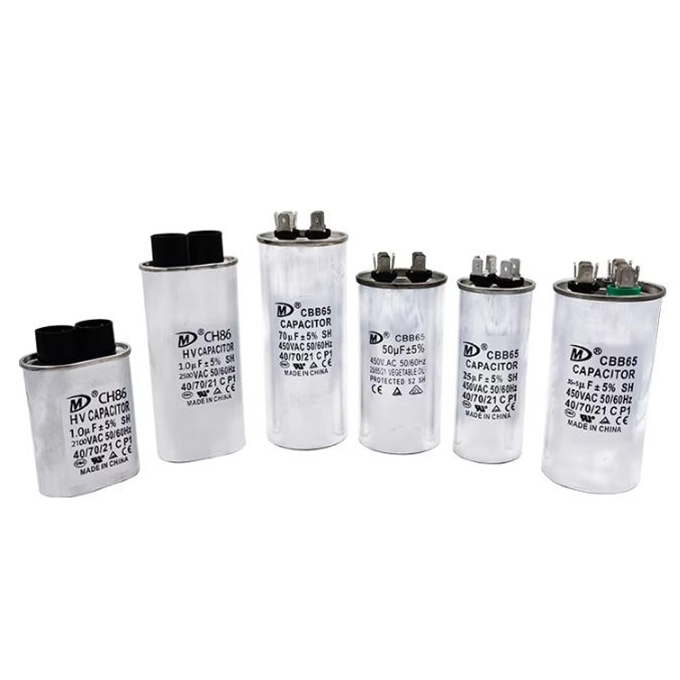
In home appliances, the CBB65 450VAC AC motor run capacitor is a specialized component engineered for air conditioner and refrigerator compressors. Unlike standard capacitors, this model is optimized for refrigeration systems that undergo frequent start-stop cycles, extreme temperature swings, and volatile line voltage. Thanks to its reliable performance, high safety rating, and long service life, it has become a standard critical part for residential and commercial cooling equipment.
1. Basic Product Definition & Core Purpose
CBB65 is a widely used designation in China for metallized polypropylene film AC capacitors. It falls under the category of dry-type self-healing low-voltage shunt capacitors and is the mainstream run capacitor for appliance motors. The designation breakdown: "C" stands for capacitor, "B" for polypropylene film dielectric, the second "B" for shunt application, and "65" is the dedicated series code built for continuous AC motor operation. 450VAC is its key rated specification, meaning it can sustain 450 volts of alternating current continuously. It is well suited for the 220V residential power supply in China and withstands grid voltage fluctuations and voltage spikes during equipment startup.
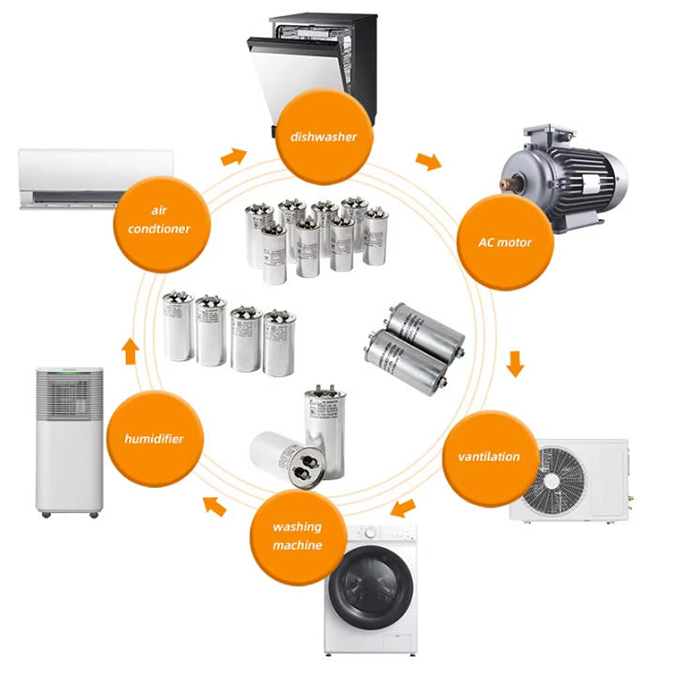
Different from start capacitors designed for short-duration operation, this is a continuous-duty run capacitor. It does not only help the motor start; it stays active throughout the appliance’s operating cycle. It is commonly paired with compressor motors in split home air conditioners, central air systems, upright refrigerators, freezers, and small refrigeration units.
2. Operating Principle & Core Function
To understand the capacitor’s role, it helps to know the limitation of single-phase AC compressor motors. Single-phase alternating current only generates a pulsating magnetic field in one direction and cannot produce a rotating magnetic field on its own. When power is applied, the motor will merely hum and vibrate instead of spinning. Even with external help to get it turning, problems like unstable speed, insufficient torque, high power draw, and excessive heat will occur. The primary job of the CBB65 run capacitor is to resolve this issue through phase shift compensation.
In the circuit, the capacitor is wired in series with the compressor motor’s auxiliary winding. Leveraging the electrical properties of capacitors — passing AC while blocking DC, plus delayed charging and discharging — it shifts the current in the auxiliary winding roughly 90 degrees ahead of the current in the main winding. The two currents with a 90-degree phase difference combine to create a uniform circular rotating magnetic field. This delivers ample starting torque so the compressor motor turns on smoothly and quickly reaches its rated speed.
After startup, the capacitor remains in the circuit and continues to provide reactive power compensation. It cleans up the motor’s current waveform, cuts reactive power loss in the circuit, reduces motor heat buildup and wasted electricity. It also cushions the compressor from grid voltage swings and sudden current surges, stabilizing motor speed. This prevents inconsistent compressor rotation and fluctuating cooling output, fundamentally improving the refrigeration system’s operational stability and energy efficiency.
3. Material Design & Manufacturing Advantages
Compressors produce constant vibration and heat during operation. Ordinary capacitors often fail prematurely with dielectric breakdown, bulging, fluid leakage, or complete failure. The CBB65 capacitor uses premium materials and construction built to handle harsh refrigeration operating conditions, with standout structural and material benefits.
For dielectrics and electrodes, it uses metallized zinc-aluminum polypropylene film as its core dielectric and electrode material. Compared to traditional polyester film capacitors, polypropylene film offers superior insulation, extremely low dielectric loss, and excellent heat resistance. The zinc-aluminum composite metallized coating not only stabilizes electrical conduction but also gives the component robust self-healing properties. When voltage spikes create tiny breakdown spots in the film, the metal coating instantly vaporizes to isolate the damaged area, restoring insulation. This prevents short-circuit failure and greatly boosts surge resistance and service life.
For the housing and sealing, most versions adopt a fully sealed cylindrical aluminum can with vacuum potting using high-temperature flame-retardant epoxy resin. Aluminum housing dissipates heat far better than plastic casings, rapidly removing minor heat generated during operation and preventing thermal aging. The hermetic seal blocks water, dust, moisture, and oxidation, making it suitable for outdoor AC condenser units and damp back-of-kitchen refrigerator environments. The capacitor also integrates a pressure-activated burst safety relief mechanism. If internal pressure rises abnormally, it releases pressure automatically to eliminate risks of bulging, rupture, or fire, meeting P2 safety standards and outperforming ordinary household capacitors.
In addition, it uses a vacuum vegetable oil impregnation process with no solid impurities inside for more consistent electrical performance. Its dielectric will not solidify or degrade in cold temperatures, supporting a wide operating temperature range of -40°C to 85°C. This handles extreme seasonal temperature changes for outdoor AC units and steady cooling conditions in refrigerators.
4. Key Technical Specifications & Performance Standards
The 450VAC capacitor follows a standardized specification set and complies with China’s GB3667 national standard. It delivers precise parameters and broad compatibility as an OEM and replacement part for refrigeration equipment. Major specs are listed below:
Rated operating voltage: 450VAC, compatible with 50/60Hz mains power. It runs reliably on 220V household power and can withstand transient surges up to 1.5 times the rated voltage, protecting against grid surges and high-voltage shocks during cycling. Capacitance range covers 1μF to 100μF, with common ratings at 20μF, 25μF, 30μF, 35μF, 40μF, and 50μF. Capacitance tolerance is tightly controlled within ±5% to maintain balanced, stable motor power output.
For electrical performance, insulation resistance ≥3000S provides excellent insulation to avoid leakage and short circuits. Its dielectric loss is minimal, so self-power consumption is negligible and does not add to the appliance’s energy load. Its climate classification meets the 40/70/21 standard, retaining stable performance and anti-aging properties in extreme temperatures from -40°C up to 70°C.
5. Core Application Benefits
As a critical companion part for compressors, capacitor quality directly determines cooling performance, energy efficiency, noise levels, and equipment durability.
First, it ensures reliable startup and shutdown to prevent unexpected downtime. More than 90% of cases where an outdoor AC unit or refrigerator compressor hums but fails to start, or shuts down seconds after powering on, stem from an aging run capacitor. The stable phase-shift capability of the CBB65 supplies sufficient starting torque for the compressor, ensuring reliable startup every time. It avoids motor overload and circuit burnout caused by repeated failed startup and keeps refrigeration systems running around the clock.
Second, it boosts cooling efficiency and cuts power consumption. When a capacitor fails or its capacitance drifts too far from specs, compressor motor torque drops and the unit cannot reach rated operating power. This results in slow AC cooling and poor refrigerator temperature reduction. Motor reactive power loss also spikes and power bills rise. The capacitor accurately compensates phase and improves circuit power factor, keeping the compressor running at its efficient rated operating point for faster cooling and reduced wasted energy over time.
Third, it cuts operating noise and extends equipment lifespan. Poor capacitor stability causes uneven compressor rotation and increased mechanical vibration, creating a noticeable hum. This disturbs living spaces and accelerates wear on compressor bearings, pistons, and other moving components.
Finally, it strengthens equipment safety. With layered safety features including pressure relief, self-healing dielectric repair, and full sealing, the CBB65 capacitor mitigates hazards like electric leakage, short circuits, and fire triggered by voltage fluctuations, thermal aging, and humid conditions. Built for continuous power-on operation in household cooling appliances, it safeguards safe equipment operation.
6. Common Failure Signs & Maintenance Tips
Knowing how to spot faults and maintain the unit helps quickly diagnose issues and lower repair costs.
During daily use, symptoms such as a non-spinning outdoor AC unit, sudden cooling loss, startup noise, frequent cycling, a refrigerator compressor running nonstop while cooling poorly, or excessive cabinet heat usually point to capacitor aging and failure. Visual inspection may reveal bulging, fluid leaks, deformed casing, or oxidized dark terminals. When tested with a multimeter, if measured capacitance falls more than 10% below the marked rating, the capacitor has failed and needs prompt replacement.
For routine care: keep outdoor AC units and refrigerator machinery well ventilated and dry. Avoid exposing capacitors to standing water, heavy dust, or direct intense sunlight to slow aging. Periodically clean cooling filters and exterior dust buildup to prevent overheating from poor heat dissipation. Minimize frequent on-off cycling of the equipment to reduce stress from repeated voltage spikes. When replacing the capacitor, always match the original 450VAC rating and capacitance value. Substituting lower-voltage or mismatched capacitors will lead to recurring failures and may burn out the compressor motor.
A high-quality CBB65 450VAC capacitor is a foundational component for reliable refrigeration equipment repairs and stable system operation. It fills an irreplaceable role in HVAC and cooling home appliances.
.jpg)


Subscribe for more updates
Get instant updates about our new products and special promos!
